Wednesday, July 20, 2016

Connecting the letter name and symbol

Connecting the symbol and letter name (and letter sound) activities available are overwhelming.  There are no quick ways to learn just be patient and persistent in practice.
Let the children know that it is their responsibility to learn.  

NOTICING letters everywhere. 
Name Cards - Using the students' names is the most personal way to hook into "it's important" because they are important.  
Cheer the letters in their names.
Sing the letters in their names.

Find letters on:
Cereal Boxes


Clothing


Posters and Cards
Use posters to look at while singing the ABC song in order but also point to the letters out of order.  Singing the song can help as a hook to 'figure out' unknown letters out of order.  Mini posters and alphabet lines can be used for students to keep close when trying to remember the letter names.


'Flashing' (flipping) cards  to say it fast.

Sentence strips made with letters in uppercase and/or lowercase form to read the letters.


Students can be the 'teacher' to help and encourage each other. 
Letter naming challenge - Divide students into two teams, showing a letter card to first students in each line.  The team who names the letter first gets a point.

Alphabet arcs -Students match plastic letters to an outline on the card. 


Letter manipulatives can be:
Plastic letters
Magnetic letters
Foam letters
Wooden letters
Felt letters
Letter tiles
Letter blocks
Write letters on bottle caps
Magnetic letter cards


Something to do with letters:
Put it in a sock-  Put plastic, wooden or foam letters in a sock.  Students reach in and 'feel' the letter trying to guess what it is.  Use letters that the form can be guessed more readily.  T,  X,  C,  E, O.  A mat could be made so as student pulls out a letter, they can match it to a letter (traced) on the mat.  Limiting the selection and giving a hint what the letters in the sock are, helps students focus and be successful.

Varying the hands-on items keeps the children's curiosity.  Remember this age just loves to touch!

Technology
I found a free ipad app called ABCSound-Lite .  It is a phonics visual song that follows the Discovery Toys Sounds Like Fun CD song "Letter Sounds" by Barbara Milne.  "apple, apple, /a/-/a/-a/"  The online and current Discovery Toys song has changed some of the pictures from when I originally purchased.  

  • Starfall.com uses alphabet blocks that when selected by the student, helps practice identifying the letter and hears the letter sound while clicking.  Some activities match initial sound and letter form.
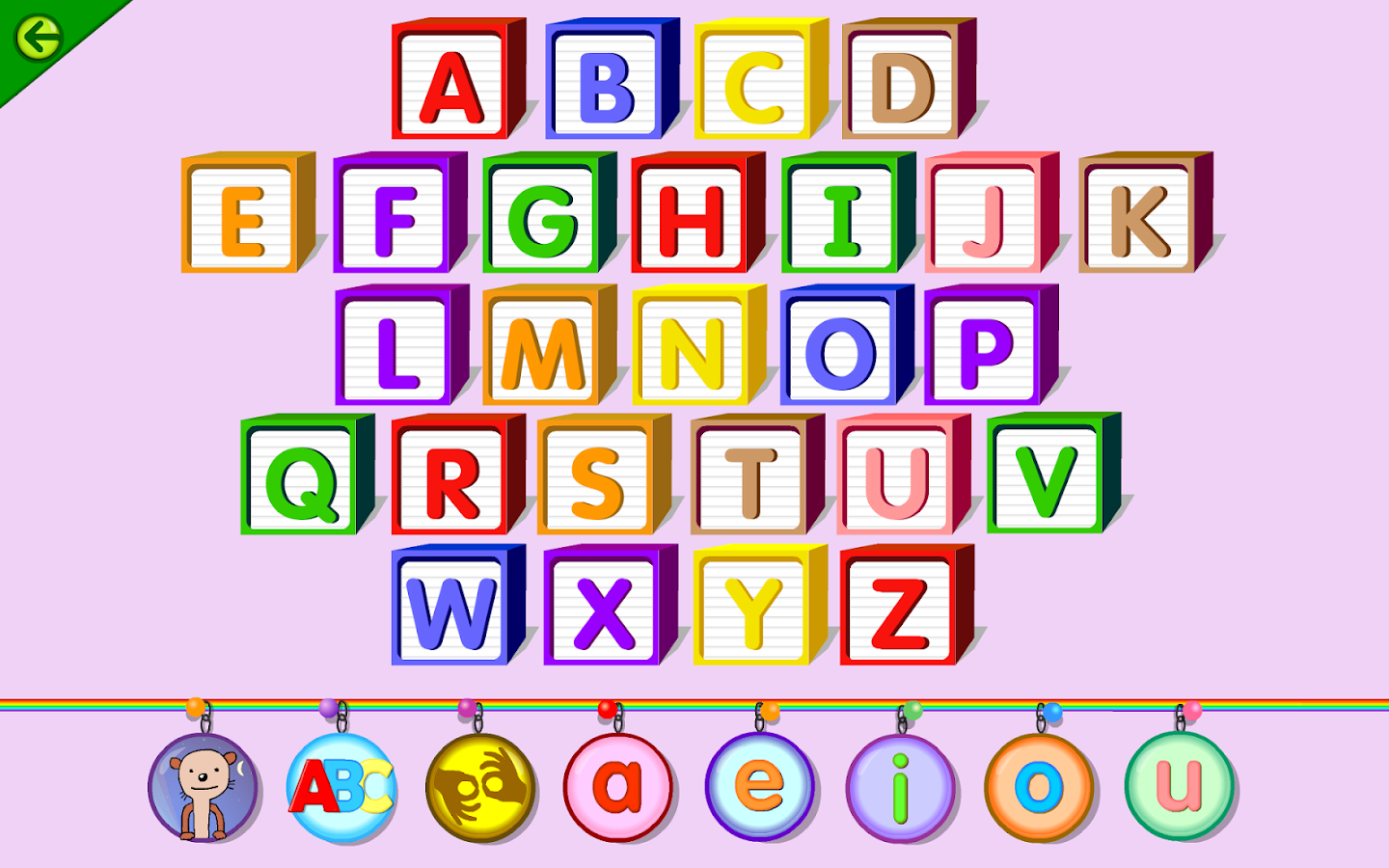
 
  • Reading Eggs.com  is a subscription site that assesses and moves the students along a program of lessons for developing phonemic awareness and phonics skills for reading progress. 
Games (there are so many)
Calling an activity a 'game' intrigues most children to play with letters.  

alphabet recognition:
  • memory match
  • letter lotto
  • Go fish with letter cards
  • matching magnetic letters 


These games can be adapted to vary practice for:
identifying the lowercase form,
identifying the uppercase form,
matching uppercase to lowercase,

Walk the halls searching for the letters.  
Take a walk and ask the children to find an A a,  B b,......  In order and out of alphabetical order.

I Spy
Make pages with random letters in various fonts, sizes and pictures.  Children can use a bubble wand and spy the letters with a partner or as a small group practice.  I made these, if you're interested leave me a comment. 


Writing Letters
Write in alphabetical order.  Write letter pairs.
Select a letter  "make a Dd"
Say the letter name while writing.  D  d 
Model 
-write it in the air (large to smaller)
-write with dry erase boards


Include stories to read and point out letters. 
Chicka, Chicka, Boom, Boom  by Bill Martin, Jr.  
(a separate post coming with more ideas)
Dr Seuss' ABC


Singing and body movements connect with letter sound.
Dr. Jean's  "Phonercise" and "Go Letters: Cheer" are on YouTube or in CD.


The more they practice (right),
the better they get! 

Tuesday, July 19, 2016

SINGING THE ALPHABET


In my early days teaching kindergarten, I didn't think it was important to be able to sing the ABC song.  We taught the letters out of order and didn't want to give the false impression that if you can sing the song  "now I know my ABCs..."  Now, I think it is a good hook and it is important to be able to do it. 


I have a set of carpet squares that I use often in directing students to 'sit on the letter m'.  As they are dismissed to their workjob, they have to pick up their carpet square and tell me the name of the letter (shape, number).  If they don't know it, they can ask a friend. 

After the first few days of school, I begin playing an "ABC song" as the children enter in the morning.  I have an alphabet poster hanging under my easel and another one near our large group area.  I also have the traditional alphabet line above my chalkboard.  Gradually I have added alphabet sentence strips and cards around the room.
This is a copy from Discovery Toys CD "Sounds like Fun".  I like the use of the lowercase letter form used.
If you can't get a copy, just make your own with beginning sound pictures.  
I point to just the letters on closest available poster as we practice singing the traditional ABC song.  I want the children to begin to notice around the room.  

I also am still using the letters in their name to build their name for recognition and naming the letters in classmates names.  

After doing singing the traditional ABC song for a week, I introduce the "Letter Sound Song" from Discovery Toys and point to the poster for a visual. The song/chant is simple and repeats each line.  Teacher can say it first and students repeats.
"apple, apple,  /a/, /a/, /a/   (repeats)  apple, apple,   /a/, /a/, /a/
baby, baby      /b/, /b/, /b/ .."  *be sure you do not say /buh/
               
I really like this way to connect the first sound, isolated sound and later letter recognition.
"apple, apple,  /a/, /a/,  'a' (say letter name)


I have made a smaller, black and white version for the children to practice with.  This requires them to point one to one and follow along, left to right and repeats.  Any alphabet chart works well.  It is ok to switch types of alphabet print cards to push for one to one accurate pointing.  You might learn that certain formats work better with certain groups.  Use your professional discretion.

We continue to add other "ABC song" versions.
I like:
Greg and Steve's "ABC Rock" 

Dr Jean's "Nursery Rhyme Rap" (this includes singing the alphabet song between nursery rhymes)

I am also very conscience about enunciating each letter  name correctly and slow down at "l,m,n,o,p"  and "t,u,v". 
(good phonics and speech skill)

The first homework activity is the children take home a mini alphabet poster that they are required to point to the letters while singing/reciting the ABC song.  
Then I assess them on their ability to do this.  Before they point to the card, I just ask them to sing the ABC song.  
One year I asked a little boy to sing the ABC song.  
He looked at me rather oddly 
and said "well, ok.  ABC, it's easy as 1,2,3...."   
gotta love them!

  • Write random uppercase and lowercase letters on sentence strips and practice just reciting the letters.  This can be done with the whole group, small group or in student pair.   If you're familiar with Dibels, this prepares them with 'Say It Fast' LNF. (letter naming fluency)

Continue chanting variations with individual cards.


First just show card and say letter name. Then connect the letter and sound.
"A...apple..../a/"  in order and then out of order.

Starfall.com has an alphabet blocks game.


YouTube has many videos to sing/say and see.  


I like Havefunteaching phonics song video to just sing the alphabet and then there are "jazzy" (yeah, my oldness term)  segments to connect the sound with each letter. 
 

Singing and body movements connect in another way.
Dr. Jean's  "Phonercise" and "Who let the letters out"
"Go Letters: Cheer" are on YouTube or in CD.

Next blog will be more about connecting the letters with the sounds.  Whenever you use a visual you are beginning the connection. 


 The more they practice (right)
The better they get!

Monday, July 18, 2016

Hand-in-Hand


Hand-in-Hand

This is how I hope to try to be living my life.  If I have missed my opportunity, then I apologize.  We all have our struggles and challenges.

There are 3 basic rules in my class.
1.  Be nice*
2.  Listen
3.  Do your best


This generation is growing up with a strong technology influence.   Me, me, me.
I saw a news interview with Dr. Michele Borba.  She has written a new book called, Unselfie.  I have read her website micheleborba.com   She has written books, articles and speaks about parenting strategies.  She has written on her blog,  "42 Ways to Raise a Kind Child."


These are some of my ideas:

HOLDING HANDS
I still think it is important to hold the hand of the first child in line.  (My assistant automatically holds the hand of the student at the end of the line.) This simple gesture makes the line leader at the beginning and the 'end of the line helper' a chance to feel special.
Thus holding hands.......we don't do it enough.


LINE BUDDIES

This past year I had a challenging class.  They were very bright but socially, they did not mesh.  So I tried "Line Buddies" the last few weeks of school.  A Line Buddy is another student they are assigned to be with.  I randomly selected the first buddy for the week.  Although our school hallway line procedure is in a single line, I knew my students needed to learn about looking out for another person.  Some pairs held hands, some put their arms around each others' shoulders. As long as it was not distracting, it was their choice, I didn't comment as long as they walked together.   Five-year olds are naturally empathetic.  We just need to allow them the chance.  Line buddies has helped when the children line up from recess, they look for their line partner.  Buddy up!  Look out for each other.


HEARTPRINTS
 Heartprints Ideals Childrens Books,http://www.amazon.com/dp/0824954505/ref=cm_sw_r_pi_dp_zMc3rb13KYZ135EB:

I found this charming book by P. K. Hallinan called Heartprints.  I read this at the beginning of the year and especially on birthdays.  I encourage the children to think of something kind to describe the birthday child.  We write a brief story by completing sentences about their favorite color, food and what they like to do in kindergarten.  Some years, I just have the students sign their name next to the heart on the back of the story as we would for a birthday card.  Some years, I have the students tell a word describing something about the birthday child.

Individual Behavior Home Report
For some students, I have tried a Think About it form that the students would fill out when they have broken a rule.  For other children, I have developed a form that I fill out when they are 'caught' doing something nice.  It seems to be more effort on our part to catch the good acts rather than the misbehaviors. 


Catching children doing good for others, learning, being nice can set the best expectation example for the class.


Keeping things simple so it can work.