Showing posts with label songs. Show all posts

Saturday, September 3, 2016

Ten Day

So we do things the 'ten way'.  
You can do this any time of the year for a variety of ways of ten fun.  Somethings are too difficult on just the tenth day of kindergarten.

Fingerplay
The kids love this because we ham it up when we say "would you like to see?"
I HAVE TEN LITTLE FINGERS

I have    (point fingers/hands toward chest)
ten little fingers   (spread all fingers wide)
And they all belong belong to me.  ( point fingers to self)
I can make them do things
Would you like to see?

I can shut them up tight.   (close up fingers tightly)
Or open them wide      (spread fingers wide)
 I can put them together   (fingers together and palms together under chin)
Or make them all hide.   (put hands behind back)...like where are they?

I can make them jump high. (wiggle fingers and hands up...make voice high pitched when saying the word high) 
 I can make them go low.  (wiggle fingers and hands down..make voice low pitched when saying the word low)
I can fold them so quietly.   (fold hands together)
And hold them just so.   (sit down while putting hands in lap, criss-cross legs)
 (can make voice at a whisper soft level for last line)

1,2,3,4,5 
1,2,3,4,5 once I caught a fish alive.
6,7,8,9,10 then I let him go again.
Why did you let him go?
Because he bit my finger so.
Which finger did he bite?
This little finger on the right.

Finger Counting
Practice showing quantity of fingers 1,2,3...10.  This develops finger dexterity and control.


Then ask students to put hands behind their backs and say..
Show me....3 fingers and students show quickly.  


Plink counting  
You need a glass jar and some pennies.
Children should close their eyes and listen while you drop pennies into the jar.  Tell the children to open their eyes and ask a few how many pennies they think were put in the jar.
It is interesting that this is difficult for some children at first.  After a few students give their answer, say 'let's check it.'  With their eyes open now, take out the pennies and drop them in again while they count out loud.  
I do this ocassionally throughout the year, increasing the amount between 1-20. 

Counting stations
Set out items to count into groups of ten such as:
links to make a chain of 10
unifix cubes to make a stick of 10
1" wooden cubes to stack
lego blocks to stack
1" tiles
pennies to stack
cups to stack
beads on a string
And rotate the children to try counting  various manipulatives.  Clean up (take stacks apart) before moving to next counting station.

Art Centers
Using bingo dobbers, to make a picture or design using  only 10 dots.   Or make 10 dots and draw a picture around using the dots. 

Playdoh
Make 10 smooth balls.  Make 10 snakes or worms.  Make 10 small pancakes.

Toothpicks
Give students 10 toothpicks and challenge them to make something.    (2-d, 3-d)

Patterning
Make an AB, AAB, ABB pattern using bottle caps, colored cubes, shapes, etc.  Or challenge them to build a pattern and label it.  They must prove it is a pattern.  And they can only use up to the amount of 10 to show it. 

Songs of Ten
"Ten little Indians"  counting forward and backwards.
"Count Up Count down" song by Hap Palmer.

Game of counting in group.
Stand children in a circle or a long line and begin to count.  The child who says 10 has to sit down.  Continue until only one child is standing.

Stories
Ten Little Ladybugs 

Ten Black Dots 


Ten, Nine, Eight


Feast for 10


Dominoes
Challenge children to find a domino with 10 dots on it and record how many on each side that total 10.  
(4 and 6 make 10)

Dice
Using 1 die, roll and count dots.  Record how many dots from each roll.  Record number of dots with a different color until they reach 10.  Cannot go over 10 or they need to start over.  

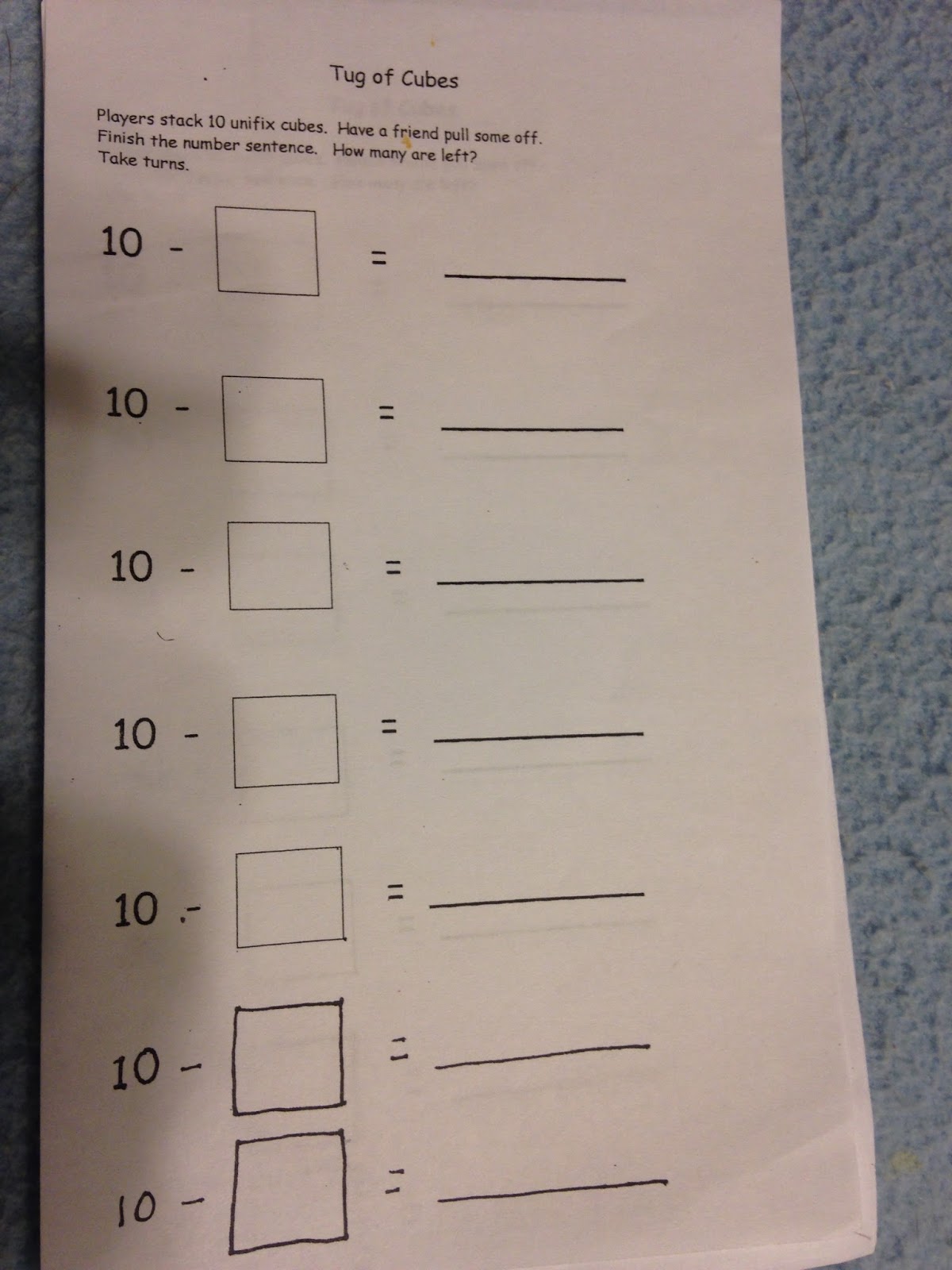
Tug of Cubes
Students each count a stack of ten Unifix cubes.    
First player holds out their 10 stack and partner breaks stack and puts it behind their back.  First player has to figure out how many they took.  Count the number of cubes they have left.  (10 take away 3 left means that 7 were taken).  Partner shows the taken away stack and returns it.  Player two gets their turn.   Later in the year students can record their number sentence as 10-3 = 7.

Show and Tell 
Good old-fashion, show and tell.  Give the children a zip bag with instructions to put 10 things in it and bring it to school.  Are the items in the bag all the same?  What variety of collections of 10 did the children bring in?   Sort collections by color, edible or not, hard or soft, etc.

 The more they practice,
the better they get!
 

Thursday, August 11, 2016

Week 1: Group Games and Other Name Activities

It goes without saying, you can do these anytime of the year.  Week 1 is a good week to introduce these.

Learning each others names by hearing and seeing.
GROUP GAMES

Play name games this week.  It will help everyone learn each other's names and feel connected and important.
  • Sing "The More We Get Together" and include the children's names.
  •  Adapt Fingerplay "Where is Thumbkin?" and use children's names.  "Where is Jaiden?" and Jaiden answers, "Here I am!" and waves to class. 
  • "Who stole the cookies from the cookie jar?"is the kids all time favorite circle name game.
Sit in a circle.  Clap knees and hands in rhythm while saying,
"Who stole the cookies from the cookie jar?"
"__student name___stole the cookies from the cookie jar"
(Student responds). "Who me?"
(Class says)  "Yes, you!"
(Student says ) "it couldn't be"
(Class says). "Then who?"
(Student says another classmate's name)
Chant continues with next name.

The first few times playing, I just go down the circle line.   If student doesn't know the next child's name, they need to ask softly "what is your name?"  This helps practice how to ask someone a question and how to answer a question.
When everyone seems to know how to play the game and classmates' names, then any name could be chosen to go next.  Each person only gets one turn.  My name is usually chosen last and I never admit that I took the cookies,  "could be?!"
Adaptation:  Write students' names on a cookie shape.  Pull out a cookie as the next chosen.  Students will begin to read friend's names.


  • Adapt the story of Brown Bear, Brown Bear, What do you see? to recite names.  Children sit in a circle and chant the phrase , "Mason, Mason, Who do you see?"  then Mason would say student's name next to him.  "I see Kira looking at me."  Class chants Kira's name and it continues around the circle.  IF a child forgets the next person's name, practice asking "What is your name?"    
  • Guess Who is missing? 
 One student is selected to be the 'guesser' and turns their back (goes in the hall to wait, closes their eyes...)  Teacher holds up a name card or taps a student to hide away from the group.  The guesser returns and class chants "Who is missing?"  The guesser tries to guess who is NOT in the group.  If needed, a clue could be given,  It is a boy.  or She is wearing a red shirt.  


A PICTURE CAN TELL ALL...
Matching names and pictures:
  • Take pictures of students and use the pictures to hold up and class has to say the student's name.
  • Use the pictures to match the picture to classmate's name.  
Writing names to pictures:  
  • Make a page with students' pictures and their name.  Classmates can practice writing the names on another paper.  You can make a class book and title it, "These are my school friends."


  • Give students a clipboard with paper.  They love to write on clipboards and making their own list of friends' names.  Sometimes they say it is a list of those they want to invite to their birthday party.
      Students can take class surveys asking:
    Yes  No Questions
    Do you like ice cream? 
    Do you have any brothers (sisters)?
    Do you have a pet? Do you have a dog (cat)?
    Do you know how to tie your shoes?


    Students names are written under the answer yes or no. 


    Tracing names and rainbow writing letters:
  • Make a sheet in grey print of students names to practice tracing the letters.  Vary tools to write with from markers, crayons, colored pencils.  
  •  Write or print name in large print or bubble font and place page in clear zip bag for playdoh snake writing.
  • Using large print name students can paint over letters
  • Print name with a black watercolor marker and students can water paint over the letters to watch them bleed.  They think it's cool. 


  • Shaving cream writing
 
.

  • Use letter stamps to sequence letters in name correctly.

    And the more they practice,
    the better they will get.
     

    Tuesday, July 19, 2016

    SINGING THE ALPHABET


    In my early days teaching kindergarten, I didn't think it was important to be able to sing the ABC song.  We taught the letters out of order and didn't want to give the false impression that if you can sing the song  "now I know my ABCs..."  Now, I think it is a good hook and it is important to be able to do it. 


    I have a set of carpet squares that I use often in directing students to 'sit on the letter m'.  As they are dismissed to their workjob, they have to pick up their carpet square and tell me the name of the letter (shape, number).  If they don't know it, they can ask a friend. 

    After the first few days of school, I begin playing an "ABC song" as the children enter in the morning.  I have an alphabet poster hanging under my easel and another one near our large group area.  I also have the traditional alphabet line above my chalkboard.  Gradually I have added alphabet sentence strips and cards around the room.
    This is a copy from Discovery Toys CD "Sounds like Fun".  I like the use of the lowercase letter form used.
    If you can't get a copy, just make your own with beginning sound pictures.  
    I point to just the letters on closest available poster as we practice singing the traditional ABC song.  I want the children to begin to notice around the room.  

    I also am still using the letters in their name to build their name for recognition and naming the letters in classmates names.  

    After doing singing the traditional ABC song for a week, I introduce the "Letter Sound Song" from Discovery Toys and point to the poster for a visual. The song/chant is simple and repeats each line.  Teacher can say it first and students repeats.
    "apple, apple,  /a/, /a/, /a/   (repeats)  apple, apple,   /a/, /a/, /a/
    baby, baby      /b/, /b/, /b/ .."  *be sure you do not say /buh/
                   
    I really like this way to connect the first sound, isolated sound and later letter recognition.
    "apple, apple,  /a/, /a/,  'a' (say letter name)


    I have made a smaller, black and white version for the children to practice with.  This requires them to point one to one and follow along, left to right and repeats.  Any alphabet chart works well.  It is ok to switch types of alphabet print cards to push for one to one accurate pointing.  You might learn that certain formats work better with certain groups.  Use your professional discretion.

    We continue to add other "ABC song" versions.
    I like:
    Greg and Steve's "ABC Rock" 

    Dr Jean's "Nursery Rhyme Rap" (this includes singing the alphabet song between nursery rhymes)

    I am also very conscience about enunciating each letter  name correctly and slow down at "l,m,n,o,p"  and "t,u,v". 
    (good phonics and speech skill)

    The first homework activity is the children take home a mini alphabet poster that they are required to point to the letters while singing/reciting the ABC song.  
    Then I assess them on their ability to do this.  Before they point to the card, I just ask them to sing the ABC song.  
    One year I asked a little boy to sing the ABC song.  
    He looked at me rather oddly 
    and said "well, ok.  ABC, it's easy as 1,2,3...."   
    gotta love them!

    • Write random uppercase and lowercase letters on sentence strips and practice just reciting the letters.  This can be done with the whole group, small group or in student pair.   If you're familiar with Dibels, this prepares them with 'Say It Fast' LNF. (letter naming fluency)

    Continue chanting variations with individual cards.


    First just show card and say letter name. Then connect the letter and sound.
    "A...apple..../a/"  in order and then out of order.

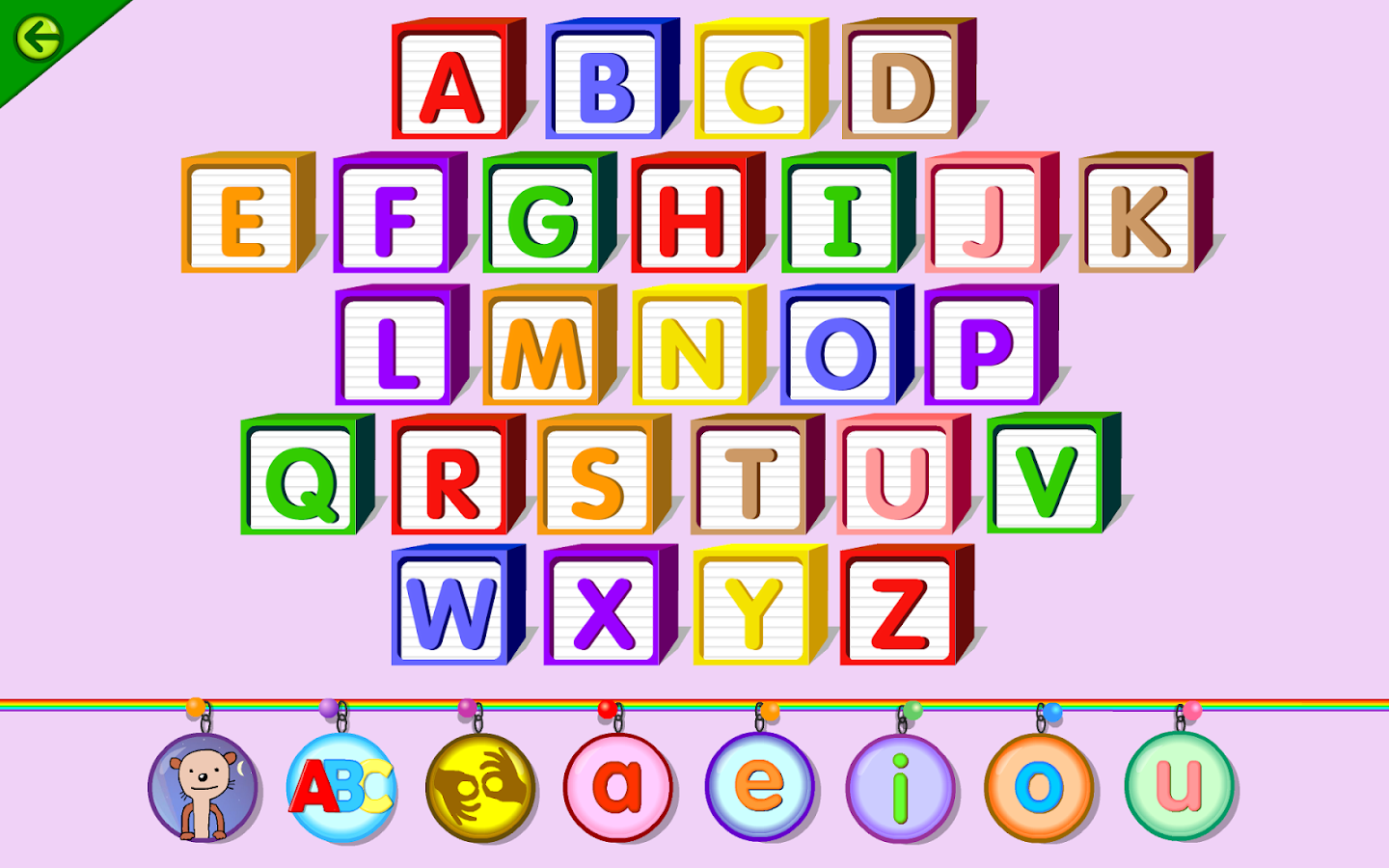
    Starfall.com has an alphabet blocks game.


    YouTube has many videos to sing/say and see.  


    I like Havefunteaching phonics song video to just sing the alphabet and then there are "jazzy" (yeah, my oldness term)  segments to connect the sound with each letter. 
     

    Singing and body movements connect in another way.
    Dr. Jean's  "Phonercise" and "Who let the letters out"
    "Go Letters: Cheer" are on YouTube or in CD.

    Next blog will be more about connecting the letters with the sounds.  Whenever you use a visual you are beginning the connection. 


     The more they practice (right)
    The better they get!

    Wednesday, July 13, 2016

    WEEK 1, DAY 1: GETTING TO KNOW YOUR NAME

    Week 1, Day 1:  Getting to know you.   

    Names -  Who are you?  I am.......

    I greet the children at the door by shaking their hand.  It is cute to see who shakes and who wants to slap my hand.  Another lesson I show them is how to shake hands when greeting someone.  I look in their faces and get down to their height the best I can.  I introduce myself "Welcome.  I am Mrs. Cantrell....(wait a second to see if they say their name and then ask "What is your name?"  "I am SO glad you're in my class."    
    OPENING SONG to learn classmates' names:

    I love Raffi's "The More We Get Together".  It gives us the tune so we can continue on our own singing, 'there's Nathan and Candy and Paul and Michael and Isaac.."  I put my hands on their shoulders and sing their name while encouraging all to say their classmates names.  "the happier we'll be" 
     

    Raffi Intro The More We Get Together YouTube - YouTube

    https://www.youtube.com/watch?v=W-MQBa4WRpI

     STORY

    My favorite first day story is The Curious Little Kitten by Linda Hayward.  It is about a little kitten who is curious and wants to know what is on the other side of each of the three fences.  She meets a dog, a goldfish who scare her and she runs back home to be safe.  Ultimately she meets another kitten 'friend'. 


    RECOGNIZING and READING  NAMES
    I have printed their first names on 'name cards' and hold up one at a time and sing,
    "Whose name is this?     
    Whose can it be?    
    Whose name is this?   
    Please look and see."

    I explain that as I hold up each name, if it is their name, they are to raise their hand and say  "Here I am" and come up front.  If they aren't sure, I will read their name for them.  ("This says  "___"  that is your name/who is ___?")
    As each child comes to get their name, I assess if they can tell me the letters in their name, in order and out of order.  
    Then they are shown how to put their name card on a pocketchart.  
    Start the row on the Top and place cards left to right, when to start a new row. 
    I am consistent with this routine to prepare them for reading and writing.  This is all choreographed with a purpose. 


    Putting their names on the pocketchart will become a daily routine as they enter the classroom.  It's like checking-in for the day.  Each morning the name cards are laid on the floor by the door so they can find their name.  It makes a quick attendance check for me and a responsibility to get ready.

    WHERE IS THUMBKIN with student's names
    "Where is Thumbkin?" is a quick and easy fingerplay.  Many children need this finger exercise to strengthen and develop control of using one finger at a time.  
    A fun version is to use students names in the rhyme.  
    We sing:  Where is Jacob?....(Jacob comes forward and says)  "Here I am..."
    Where is Samuel?...(Samuel comes up front and says)  "Here I am...."
    How are you this morning?   (they shake hands and respond)  "Very well, I thank you"
    Now sit down, now sit down.
    (another name game to remember classmates names)


    Before sending the children home, teach them this fingerplay, 
    "One Little House".

    One little house    (hold up hand into a fist for a house)
    Shut up tight  
    Open the door
    And there inside    (open hand and point to palm with opposite pointer)
    Are   1,2,3,4,5        (count fingers holding up pointer as one, two bunny ears....)
    Five little children 
    Tall and straight     (opposite pointer finger strokes counting fingers up for straight)
    Ready to go to kindergarten   (hold up both hands and wiggle all fingers--excitedly
    Don't be late!        (put hands behind back)


    They love hurrying to put their hands behind their back.  

    This sets the tone that they will be coming back tomorrow! 


    Tuesday, June 14, 2016

    Week 1 SONGS AND FINGERPLAYS

    So you're ready to plan what you will do.  I always over plan, even after all these years.  There's that HIGH EXPECTATIONS again.  So I'll call this WEEK ONE to allow for flexibility.  Oh, that's another necessary element in teaching. 
    SONGS  
    Songs are essential to use when needing an attention grabber or JUST FOR THE FUN OF IT.  Sometimes the children just begin singing while they are working.  Don't we adults get a tune in our head that we hum, whistle or sing to ourselves?
    Get your favorite list of songs to begin and end each day.
    Change up your song list to make it fresh and fun.

    I love to sing Raffi's version of "The More We Get Together".  You can use your class names to include in ..."there's Sarah, and Zhyon and..."  After a few times of singing this, I have the children cover their name tags to challenge myself to remember their names!

    Dr. Jean's "Hello, How Are You?This is good for an opening the day song.  It's going to be a happy day!

    FINGERPLAYS
    Fingerplays are fantastic to use when you need a brain and body break while going through all those procedures the first week.  

    When teaching fingerplays be methodical.
    SAY THE WHOLE RHYME TO CLASS, 
    SAY A LINE AT A TIME and class repeats. Here you can adjust repeating slower or in shorter or longer chunks as needed.  This stretches their memory.
    SAY RHYME WITH THE CLASS
    Enjoy their smiles!  Do it again.

    I WIGGLE
    I wiggle my fingers     (stretch out hand and really wiggle those fingers)
    I wiggle my toes.          (point to feet, while wiggling toes...can't see them under shoes)
    I wiggle my shoulders   (wiggle shoulders)
    I wiggle my nose.          (use #1 finger to wiggle nose, later I ask them to wiggle without 
                                              touching...can you do it?)
    Now...all the wiggles are out of me  (shake hands and arms, then clasp hands overhead
                                                                and cross legs...BE CAREFUL and safe!)

    So I can sit still          (when you say the word SIT, all should try to sit down carefully.                                  Challenge them to try this without uncrossing legs....CONTROL--
                                       practice at home) 

    As still as can be."        (hands folded in lap)


    ONE LITTLE HOUSE
    I teach this at the end of the first day.

    One little house    (hold up hand into a fist for a house)
    Shut up tight  
    Open the door
    And there inside    (open hand and point to palm with opposite pointer)
    Are   1,2,3,4,5        (count fingers holding up pointer as one, two bunny ears....)
    Five little children 
    Tall and straight     (opposite pointer finger strokes counting fingers up for straight)
    Ready to go to kindergarten   (hold up both hands and wiggle all fingers--excitedly
    Don't be late!        (put hands behind back) 

     CHANTS 
    Teacher says  "The more you practice (right)"
    Students respond "the better you get!"

    Teacher says   "Are you ready?"
    Students respond  "YES, I'm ready!"  There was a 60's song by Barbara Mason that comes to mind that begins with this line.  (dates me doesn't it)

    FREEZE 
    Use lights out, chimes, a bells, hand clapping rhythm
    Teacher says "Hands on top"
    Students respond "Everybody STOP" (puts both hands on their heads and turn to speaker)

    Also LOOK AT THE SPEAKER
    Lesson #1:  Move around the group so they have to turn their head first slightly, then their whole body to face me.  When I am talking here...where do you look?  The children think it's a game when I move from one side of the group to another. 
    S- sit up straight
    L-look at the speaker (direction of voice)
    A-always listening 
    N-never talking
    T-track the presenter (voice)

    So ..."Are you ready?" ..............