Sunday, November 6, 2016

I'm Bored!


Image result for black child thinking


"I'm bored!"  
"It's  boring!"
"They will be bored if they have to do ___ again."
  

This is one of those words that is like fingernails on a chalkboard to me.  
Over the years I've heard this way too much from parents and students, let's face it, people everywhere.

It is overused and misused.  I once heard "smart kids don't get bored, they can always find something to do."

Many times that children use the term "bored", it means they are tired or the information is too hard for them.  They don't want to put the effort into what must be done.

Parents use the term to explain misbehavior or when they want to complain that they already learned 'that.'  
So when I say 'smart kids' don't usually get bored (and I whisper it as if it is a bad word), because they can take in the known information and gain confidence they already know it.  They can take their knowledge to a deeper level of understanding.  A self-differentiation, so to speak.
For example, during a lesson about letter sounds, /m/  a student might think "hey my brother's name is  Mark and it begins with /m/.  There's a 'm' in Monday, it must have /m/ sound too."

The brain needs to have a rest at times with all the stimulus around us.  Some children just tune out because of overload.  They need time to process and rest the brain.
Some people are unaware that being quiet and listening is not to be misconstrued as being bored. Children need to learn to put effort into listening and thinking.
Image result for black child thinking

And what is wrong about being bored?
I still do NOT like that word and believe that our lives are so filled with activity that just doing nothing for a while is a good thing.  It helps us sort out what else to do, think of things, process, let our minds wander, etc. 

Image result for child thinking

Take time to WONDER.


Friday, November 4, 2016

Five for Friday November 4, 2016

.

Thank you Kasey at Doodle Bugs for linky party this week.
 .


My colleague Pam Cochran has shared a 'lesson' on coloring that she did with her kindergarteners.  
We have found that they need specific of guidance and a rubric to understand what they should be striving to do.
 We put this on a large chart tablet so they can refer to it while they work.

The more they practice RIGHT, the better they will get.


 .
 It is still pumpkin harvest time these first early days of November.  
The students traced or wrote their numbers in the pumpkins. (Differentiated lesson) 
Then they learned a partner game.  One player rolls a die and counts out the number of counters (Pumpkin erasers, candy corn or uses a bingo dobber) to cover the pumpkins in number order.  The game ends when the first player to cover-up all their numbers.
We knew these needed lots of review this week as they worked out their sugar highs from Halloween Monday.   

  
More review of matching letters.  I selected the letters that were most missed when checking letter recognition.  Students remove a letter from the pumpkin on the left and matched it to their paper.  Students could also trace the letter with a marker or use a bingo dobber.  Then place the plastic letter in the bowl on the right.  (Reinforcing the left to right habit.)
The next step is writing letter pairs and saying the letter name while they are writing.  
We have found that repetitive writing of the letter pairs whether in alphabetical order and/or as shown above, helps the students learn the letters and sticks in their memory.  It has also greatly improved their ability to write the letters.


 .
For the past few years, I have asked the children to bring in their candy wrappers and we have sorted and graphed the various kinds.
Thanks to Dr. Jean to remind and extend this to more sorting.  It inspired me to write up a list of activities.
The day after Halloween I sent home a note in a baggie requesting empty candy wrappers.  I specifically asked them to cut the end rather than tear it.  They need MORE cutting practice anyway.


They sorted the wrappers.  I found a bit more control sending one row (table, group) at a time prevented a chaotic scramble.
I taped 26 pages on the chalkboard and labeled with the alphabet.  Students took turns getting a wrapper and finding the page to tape their wrapper on.  It was clear who could and could not identify the beginning letter of the words.
The next activity was to make SETS of candy wrappers.  Again, row by row, (table or group of 5 at a time) picked up a wrapper and decided where they were adding theirs.  As each group came, it was becoming more challenging to make sure not "too many" or "not enough" on each set page. I was excited when the students used the math vocabulary words we've identified as they described each page during our conclusion.


Woohoo....CUBS win............by the way!

Friday, October 28, 2016

Five for Friday October 28, 2016

https://blogger.googleusercontent.com/img/b/R29vZ2xl/AVvXsEipMNTjrFUbOo0qBYN7-cMZoHhU7MJI6mAsSdIqLwSBygZrHzDqY8VxF0325hxEFyKJtRyTiRwO4PeJG6ynPGm4V676Mtq5yAjBSBMWqPzLrpMDPtO6hDjJUv6p5NfGCGoW9QPgDMOC6Z4G/s1600/fiveforfriday2_thumb%255B3%255D.jpg
Thank you Kasey from Doodle Bugs for the link.
 .


 This week our staff gathered Wednesday after school and decorated these cute pumpkins.  They are on display in our Media Center (library).  For a 'Fun'raiser, the students can bring in coins to add to the cans of their favorite pumpkin.  All proceeds will go to our school Relay for Life team!
 .
 Even the fifth grade students had to prove they knew the Humpty Dumpty rhyme by reciting it to each other!
 .
Go, Cubs, Go!  A tape was being played as each class viewed our creations.  So of course, the kindergarten children repeated that chant all day long!
Did I say .......Go, Cubs go!........? 
 .

Our Kindergarten visited our local pumpkin farm, Coulters in Westville, Indiana.  Here we are on the wagon ride out to the field.
Shelby found her favorite.
  
 .
I really need to keep them moving to keep their attention these days.  Making my list of attention grabbers.
  • Macarena months song helps to start our day.  Thank you, Dr. Jean.
  • Dr Jean's "Banana Song" youtube video has saved my patience :) when I need a brain break!
  •  I say, "Hands on top" They respond, "Everybody stop!"
  • "What does a flat tire sound like?"  "shhhhh"
  • "What do two flat tires sound like?"  " shhh, shhh"
  • "Tootsie roll, lollipop"   "We've been talking, now we'll stop."
  • "If you can hear my voice....(tell an action such as touch your ears, clap two times, snap your fingers....)
  • any kind of counting song, my favorite is by Discovery Toys, Barbara Milne's 'Counting to 30' and 'Counting by tens.'
  • Ringing chimes, attention bell and lights out are quick but not as effective every time.


Did you notice the candy corn guys over my tables?  Thanks to Doodle Bugs!  Love them.


Monday, October 24, 2016

Show and Tell

Show and Tell time is still an active weekly activity in my class.  In my early years teaching, I struggled how to organize this.
During sessions with C.L.A.S.S. (Connecting Learning Assures Successful Students, education-creating successful schools with collaboration skills, brain research and character education out of Carmel, Indiana), I learned during 'circle time' to allow the students to lead their talk without any adult comments. I rarely talk except to offer a topic idea or to move-it-along. I avoid judgement statements such as, 'that's nice'  or  even asking questions. 
There are many approaches to Show and Tell such as, setting a theme for the weekly focus, free choice, color, beginning sounds, etc.  I've tried them all. 


Image result for teddy bear
 
The first time we do a show and tell, the children are allowed to bring in a teddy bear for our Teddy Bear Fun Friday in early September.  The children can practice at home what they want to tell us about their bear.  Its name, where they got it, where do they keep him and so on.  I  have a tub of extra bear friends in case they don't have a bear or forgot.  The bear then gets to spend the day with the child during activities and specials. 
After that the rule is NO TOYS or stuffed animals.  I want to keep it away from, "Oh, I have that." and keep it focused on what the child wants to share to tell.
A few years, we tried changing the name of our time to "Sharing" but it was confused with bringing something for everyone to have (like a snack).
Back to Show and Tell.
Our class sits in a circle and each week a new child is designated as the one to go first.  

The child stands. If they brought something, they hold it in front of their tummy.  When they are finished, they turn left to right and we clap as they sit down.  Clapping is how we tell each speaker, thank you. Clapping also gives a movement break that some need to be an active listener again.   When it is not their turn, the item is kept behind their backs with their hands in their lap.
I insist on:
  • Active listening - hands in their laps and looking at the speaker
  • No talking unless it is your turn
  • EVERYONE has a turn to show and tell or just TELL
  •  When the speaker is finished they are to chose the next person, they tell the person next to them " __(name)__, it is your turn."  
  • If they don't know the person's name, they are to ask, "what is your name?" (it still amazes me that throughout the year some need to continue to ask)
  • There is NO PASSING.  I tried the opting out, but soon it became a habit and a few never took a turn.  So now EVERYONE has a turn.  
  • IF they don't bring something, they can TELL whatever they want.  For some children, I offer a few suggestions, to tell about what they did last night, their favorite food, color, pets, what they like to play...
  • We are patient to a point trying to move the time along.  I don't seem to have to wait too long anymore, they just get it.
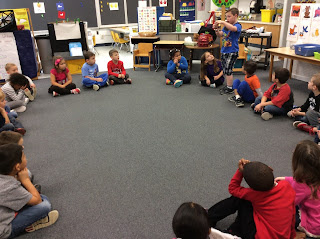
When everyone has had their turn, I now allow the children 3-4 minutes (I set the timer) to mingle.  This is the time they can get a closer look at something, or to ask something more of the presenter.  This has become a favorite of mine to watch them sincerely show an interest and ask questions.  It is refreshing to see how they beam as they show still some more.
They are learning how to SOCIALIZE in an appropriate way.

 I send a note to the families explaining the who, what, when, where, how and why we do our Show and Tell.
It includes:


Purpose:  To use language speaking skills, to speak in full sentences, to speak clearly, to build self-confidence, to explain or describe an item or event.

PRACTICE: being able to answer questions about who, what, where, when, how and why.  Stand in front of a mirror to “show” the item brought.

Ideas for show and tell:
·        Photographs (limit 2)
·        Things collected from nature
·        Crafts
·        Pictures they drew or colored
·        Book (be able to tell the name of the book, and what it’s about briefly)
·        One or two items from a special “collection”
*Items must fit in their school bag and classroom mailbox.
Student will hold items to show.  They will not be passed around the class.  When finished all items will be returned to their mailbox to take home.
Be sure to wrap or bag any breakable items.  (Be responsible with breakable items)
NO toys or stuffed animals, weapons, live animals (a photo or drawing or book about a pet is appropriate)

It takes about 20 minutes (for 25 students) and is so worth it!  

Establishing a routine helps give the students  
 structure.
  
After 4 weeks, my children can practically do it themselves.  

I say,  "Try it, you might like it!" 


Sunday, October 9, 2016

More on Syllables

In Kindergarten, the expectation for learning syllables is  verbal practice for understanding.  They will transfer this information when they begin to write and read.  These are all baby steps.
Here are a few more ideas to talk it out.
 
Nursery Rhymes that can be said in a rhythm for introducing syllables must be short with the majority having one syllable words.  Practice reciting the rhymes so they know them before using them for rhythm and syllable instructions.  I usually start with these:
  • Baa, Baa, Black Sheep - the words with 2-syllables:  a-ny, mas-ter, lit-tle
  • Humpty Dumpty -  2-syllables hump-ty, dump-ty, hor-ses, could-n't, a-gain                                    3-syllable word:  to-ge-ther
  • Little Miss Muffit - 
  • Twinkle, twinkle little star
  • Starlight, star bright                              
Say the rhymes by clapping thighs in left-right rhythm to emphasis the word parts.  Slow it down to stress the syllables.

Be sure to mention that alot of words (early sight words) have only 1-syllable.  Make a list of the sight words with the syllable count.  Many children tend to make 1-syllable words into 2-syllables.  So practice, practice, practice.

Ask the children to think of words with 1-, 2-, 3-, 4-, 5-syllables.  When the words come from them, they take ownership in this skill and prove their true understanding.

Sort pictures into groups of 1-, 2-, 3-syllables.
There are oodles of  games with picture sets I've made from Teachers Pay Teachers and Pintrest.  This is from schoolisahappyplace.blogspot.com   It has cute seasonal pictures.


Body movements help the children 'feel' their words.
Here's a mini poster I found on teacherspayteachers with a few ideas from Christine Fotia.


Change your voice while saying word parts.  Robot talking is one I like to use.

Names-  Say the children's names to practice syllables.

Earlier I mentioned about making a list of words.  This is my favorite book.  

I have had it for years (copyright 1979) and I have used it so much the pages are falling apart.  I saw an updated version on Amazon going for $177.00! (Believe me, I didn't pay that much.) Wow, it is that good!  It has wonderful lists of CVC words and words by number of phonemes, rhyming words and sentences, list of words by number of syllables, rhyming phrases, 3-word 4-/5-/6-word sentences.  Scrambled sentences, riddles, fairy tale characters, settings,  etc.  If you can ever get your hands on a copy, you'll use it often! 

 Hand-in-hand
we grow!

Tuesday, October 4, 2016

Fire Prevention Week

Invite fire fighters into class to show their gear as "friendly fire fighter".


Fingerplay
5 little fire fighters
Standing in a row
1,2,3,4,5
There they go!
Hop on the engine
With a shout!
Quicker than a wink
the fire is out.

Color, cut and sequence the five firefighters.


Stories

Clifford the Fire House Dog

 and many more....

Patterning
Use pictures of hydrants, firemen hats, boots, to continue a given pattern or make your own.

Put coloring pages in a folded book as a matchbook, to learn about fire safety.  Write 911 on front cover for emergency reference.

Envelope games
Count the spots on the firehouse dogs and match them to their firefighter with his number.


Sequentially order by number the firehouse dogs to help Fireman Frank.

 
 Put the firehouse dogs in ABC order.


Directed drawing
Direct students to make a fire truck by drawing shapes.

Don't forget to check your smoke alarm batteries!